


Blog – Timber Frame Houses
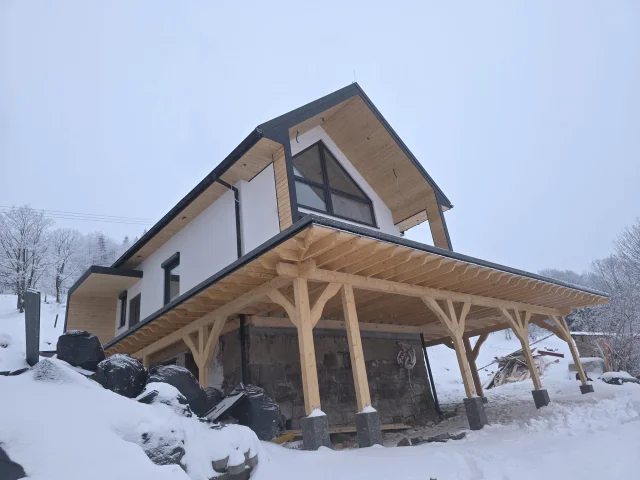
The specifics of building a house in mountainous and sloping areas – foundations vs. a lightweight frame
The cost of founding a traditional house on a sloping plot can exceed the cost of founding on flat terrain by 40–60%, according to a real-life example in the article. A lightweight frame is presented as an alternative to heavy masonry foundations.
Building a house on a steep plot is not just a design challenge, but above all, a test for your wallet and patience. Investors most often come to us with what is known as disappointment syndrome: they bought a plot in the Beskids for the view, and now every construction team that sees the slope of the land quotes a price for the foundations that consumes their entire budget reserve.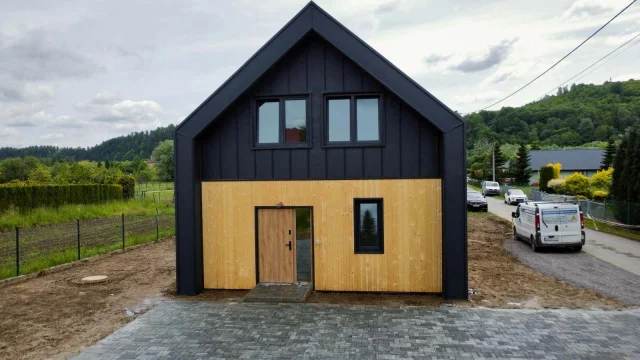
Turnkey house construction in just 3 months – is it possible and how much does it cost?
The Ekodom 110 show home in Żywiec was built turnkey in 6 weeks, which the author calls an absolute record for the crew. The case study is cited as evidence of fast turnkey construction by the crew.
For most investors, erecting a residential building is synonymous with enormous stress and years wasted on coordinating unreliable crews, but we prove that you can collect the keys to your own front door after just ninety days. Over the years, I have watched traditional methods drain people financially, which is why we completely changed our approach to managing large-scale construction projects. We developed a tight-knit process where a timber frame home and advanced timber frame technology become the optimal response to the market errors of the past. You will receive a very concrete action plan and see with your own eyes how drastically we shorten the waiting time for your desired move-in, without the slightest loss in quality of workmanship.
How to Wisely Plan the Construction of a 100m2 Single-Family Home? A Guide for 2+2 Families
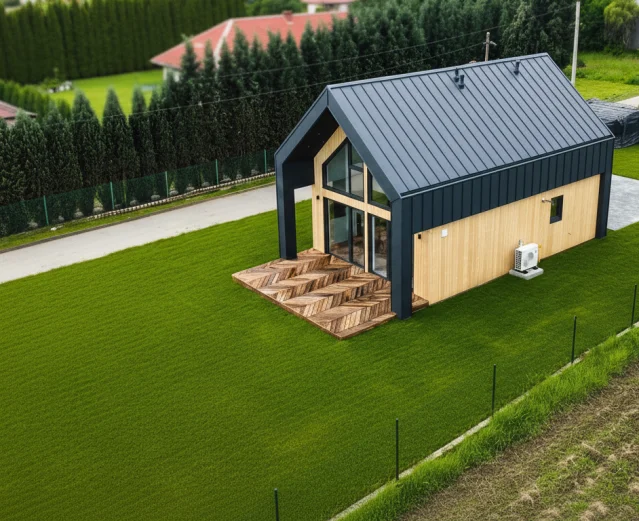
Choosing the right floor area is an absolutely crucial decision that affects your entire financial future and daily comfort. Many investors are tempted to build huge residences, which ultimately generates enormous operating costs and forces constant cleaning of empty rooms. A much better solution is the precise optimization of every square meter, allowing for the creation of a cozy and functional haven. That is why buildings with an area of about one hundred and ten square meters are currently the absolute golden mean on the real estate market.

Canadian Houses vs. Modern Frame Houses? Check the Differences
Find out why modern frame houses have replaced the old "Canadian" style homes. Learn the facts about C24 timber, WT 2021 standards, and operating costs.
Timber-Frame vs. Masonry Houses – A Reliable Comparison of Construction and Operating Costs in 2026
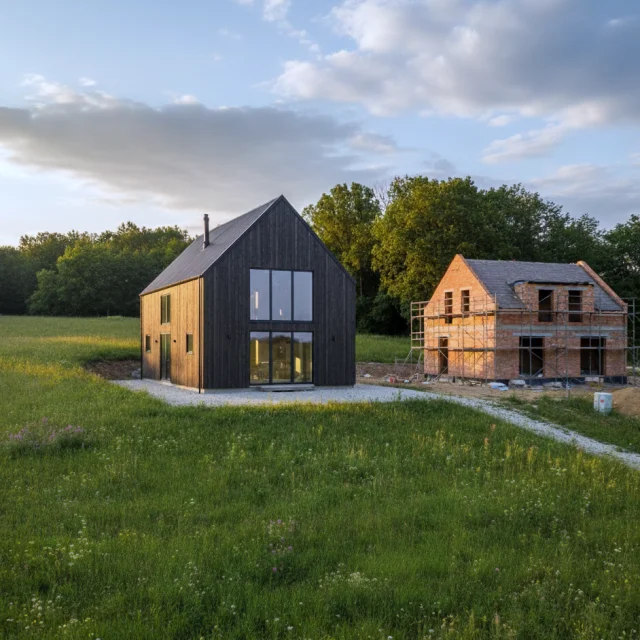
A 50 m² timber-frame house with a mezzanine costs PLN 163,000 net in a closed shell state and PLN 249,000 net in a developer-ready state in 2026, versus about PLN 175,000 and PLN 285,000–300,000 net for a masonry house.
Think "masonry" means "cheap"? In 2026, that rule no longer applies. We compared construction time, labor costs, and real heating expenses. See specific quotes for a developer-ready state and find out why timber-frame technology is the only way to protect your capital from inflation. Don't guess – see the numbers.
Timber Frame Houses in Żywiec – Why is a Local Manufacturer a Better Choice?
Response to sudden installation failures from a local manufacturer in Żywiec is usually carried out within 24 hours. The article argues that local logistics in the Beskids favor a nearby timber frame house producer.
The decision to build your own nest on difficult mountainous terrain requires a complete change in thinking about technology and work organization. Attempts to transfer schemes from central Poland to the specific conditions of the Beskids usually end in frustration and significant investment delays. Historical experience proves that local topographical conditions have for ages shaped unique methods of erecting the most durable settlements. Mass developers from distant cities most often ignore this fact, promising lightning-fast assembly on every possible plot without prior inspection. However, market analysis shows that cooperation with an experienced entity from the region eliminates the risk of failure and guarantees the smoothness of work regardless of the prevailing weather conditions.
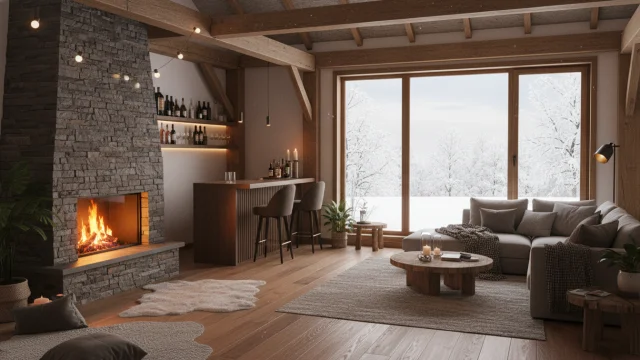
Energy Efficiency in Practice – How to Read a Home's Energy Performance Certificate?
According to the article, an energy-efficient house should aim for a primary energy result below 40–50 kWh/(m²·year). The article cites a maximum of 70 kWh/(m²·year) as an example of the EP requirement for new houses under current standards such as WT 2021.
The Energy Performance Certificate (EPC) is, for most investors, just another confusing paper to "deal with" when receiving a building or selling a property. This is a mistake that could cost you thousands in the long run. Treating this document as mere bureaucracy is like buying a car without checking its fuel consumption just because you like the paint color. In this article, we break down this document, explain what all those acronyms mean, and show you how to actually read the data so you don't overpay for utilities.
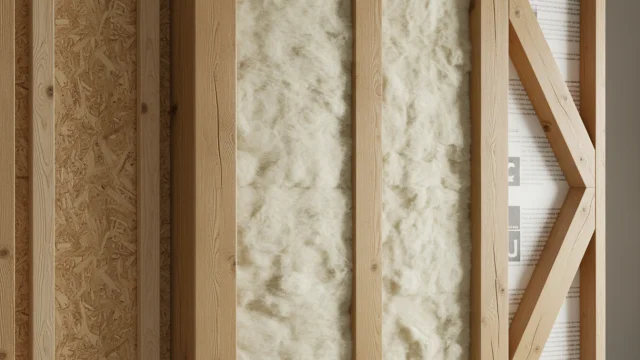
Timber Frame vs. SIP vs. Expanded Clay - A Technology Comparison
A timber frame usually saves about 10–15% at the developer-ready stage compared with expanded clay, while offering better thermal parameters.
Choosing a home construction technology is one of those decisions that paralyzes investors for long weeks. You hear about the speed of prefabrication and think it's the perfect solution, but then you get lost in a maze of conflicting information. Concrete manufacturers shout about heat accumulation, suppliers of styrofoam panels about airtightness, and we stand in the middle of this chaos. The truth is, there is no perfect technology, only those that are perfect for your lifestyle and wallet. In this article, we will break down the three giants of prefabrication into their component parts so that you can make a decision based on facts, not marketing.
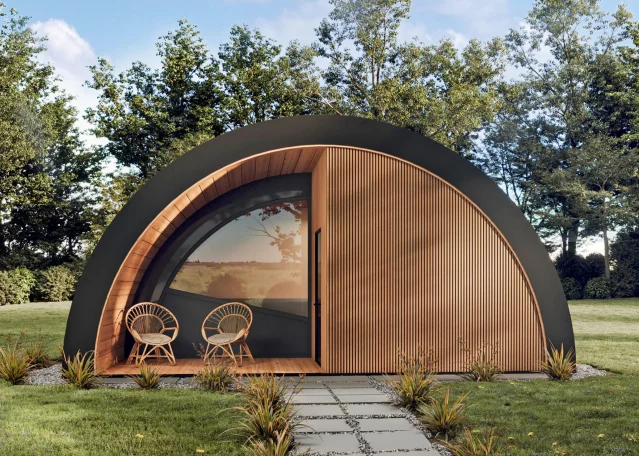
Garage, Carport, or Outbuilding? Choose Wisely for Your Modern Barn
Small single-story outbuildings, often up to 15, 30 or even 50 m² depending on the region, can be built without a full planning permission process if height limits and boundary distances are respected. On-site realization of a timber frame garage takes 4-8 weeks.
Imagine this moment: you are standing in front of your newly built, stunning modern barn. Large glazing, noble charred wood facade, anthracite roof. Everything looks perfect until your eyes fall on... a car parked under the open sky or, worse, a makeshift metal shed that was supposed to be "just for a while." This is the moment you realize that the property is a single organism. The decision of whether to build a full timber frame garage, a designer carport, or a multifunctional outbuilding will define the final character of your home. In this article, we will conduct an honest analysis of costs, aesthetics, and functionality so that you don't make a mistake that will annoy you for decades to come.
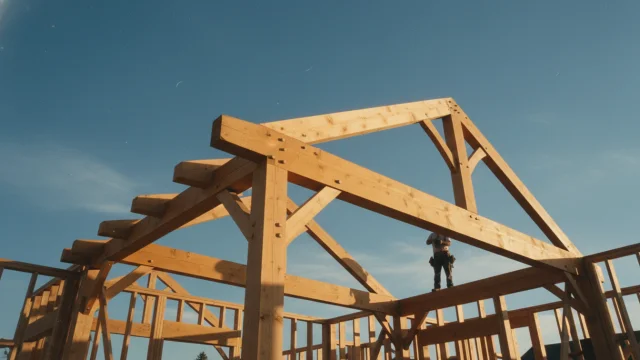
Adapting a ready-made project to timber-frame technology – is it worth it?
Adapting a ready-made masonry project to timber frame requires a new structural design, often costing 5,000 to 10,000 PLN. A timber-frame wall of about 25–30 cm total thickness can match a masonry wall of 45 cm.
Adapting a ready-made project to timber-frame technology – is it worth it? The decision to build a house is often a clash between dreams and a spreadsheet. Many investors begin their journey by browsing hundreds of pages with ready-made projects. They find the one – a perfect facade, a great room layout, an attractive visualization. But there is one catch: the project is designed for masonry technology, and you want to build in a modern, fast, and energy-efficient way. The key question arises: is converting a masonry project to a timber-frame one financially and logically justified, or is it better to invest in an individual project? In this article, we will break down this process into its constituent parts, analyzing the costs, gains in square footage, and engineering pitfalls.