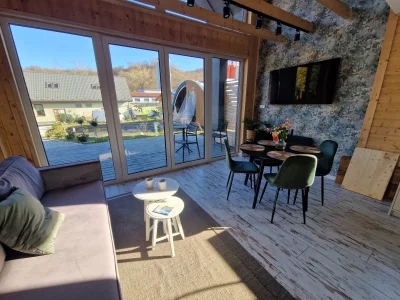


Timber-Frame vs. Masonry Houses – A Reliable Comparison of Construction and Operating Costs in 2026
A 50 m² timber-frame house with a mezzanine costs PLN 163,000 net in a closed shell state and PLN 249,000 net in a developer-ready state in 2026, versus about PLN 175,000 and PLN 285,000–300,000 net for a masonry house.

Can you afford sentiment for brick in 2026?
The decision to build a house in 2026 is a high-stakes game that keeps investors up at night due to the rising costs of traditional labor. The myth that "masonry means more solid" is slowly becoming obsolete, giving way to hard mathematics. If you are looking for a house that will not only be built quickly but also won't ruin your wallet during operation, you need to look at the numbers, not at habits from a decade ago. When choosing a construction technology, it's worth looking at ready-made projects of modern timber-frame houses that combine low costs with speed of completion. In this article, we will break down the costs incurred when building modern single-family homes, and then contrast them with the brutal reality of a traditional construction site.
Ekodom50: Small footage, big difference in price. Cost simulation
Let's start with a specific example that interests many investors looking for a starter home, a summer house, or a rental investment. Our model Ekodom50 - modern barn, perfectly fits narrow plots and the regulations for building without a permit. But how does its price compare to building a 50-square-meter house from hollow bricks?
Here is a simulation for a 50 m² project with a mezzanine (as of Q1 2026):
| Stage / Cost | Ekodom50 (System-S) Timber-Frame House Price 2026 | Masonry House (Market Average) |
|---|---|---|
| 1. Foundations A timber frame is lighter = cheaper slab/foundation. | Material and concrete savings | + approx. PLN 15-20k net (Requires massive footings and deep excavations) |
| 2. Closed Shell State Structure, roof, window joinery. | PLN 159,000 net (Fixed, contractual price) | approx. PLN 175,000 net (Risk of steel and concrete price increases during work) |
| 3. Developer-Ready State Installations, insulation, wall finishing, screeds. | PLN 244,000 net (Quick assembly, no technological breaks) | approx. PLN 285,000 - 300,000 net* (Expensive plastering, chasing, long drying time) |
| COMPLETION TIME | 8–14 weeks | 12 - 18 months |
*Market estimate including labor and materials for the WT 2021 energy-efficient standard.
By choosing Ekodom50, you not only save approx. PLN 40-50k in cash at the construction stage alone. You also save the nerves related to "paperwork" (construction by notification) and gain a year of your life by moving in almost immediately.
Construction of the Ekodom110 timber-frame house
Many of our clients ask: "What about a large house for a family?". Here, the price differences are even more visible. Let's look at the Ekodom110 model. It's 105.08 m² of usable area, a living room with a kitchenette, two bathrooms, and as many as 4 or 5 bedrooms. This is a full-sized all-year-round house.
Cost of building the Ekodom110 timber-frame house (developer-ready state): PLN 439,000 net.
Let's try to find an alternative at this price:
- Apartment in the city: In 2026, for PLN 439k in a large city, you can buy a studio or a small two-room apartment (approx. 35-40 m²). With System-S, you get over 100 meters for the whole family.
- 100m² masonry house: Bringing a traditional building of this size to a developer-ready standard, while maintaining high insulation norms, is an expense of around PLN 550,000 - 600,000 net (calculated on a commissioned basis).
The choice is simple. Ekodom110 offers an unbeatable price-to-size and functionality ratio, unattainable for a traditional "brick" house in the current economic reality.
Timber-frame vs. masonry costs – where is your money escaping?
Building with the self-build or traditional method is often a financial "bottomless pit". When you choose masonry technology, you have to account for:
- Long drying process: Plasters and screeds mean thousands of liters of water that must evaporate. This generates costs for heating an empty building to "draw out the moisture".
- Labor cost inflation: A construction lasting 2 years exposes you to drastic increases in the rates of construction crews.
- Opportunity Cost (Rent of Lost Chances): If a masonry construction takes a year longer than a timber-frame one, and during this time you are renting an apartment for PLN 3,000 per month, you are effectively losing PLN 36,000 that you could have spent on interior finishing.
- When analyzing the budget, don't forget to check what exactly theturnkey finishing standardincludes to avoid hidden costs on the construction site.
Thermal bridges – energy-efficient house profit calculation
Construction costs are one thing, but operating costs are your home's second life. Here, timber-frame technology outclasses traditional walls. The key is insulation and the elimination of thermal bridges.
"In masonry construction, we fight thermal bridges by trying to cover them with a thick layer of styrofoam. It's like treating the symptoms. In our timber-frame houses, like the Ekodom110, the wall structure is entirely filled with insulation. Wood itself is an insulator, not a conductor of cold like concrete or ceramics. In our case, the wall is not 'insulated', it is 'warm' throughout its entire cross-section. This is a difference you will feel with every electricity bill."
— Technical Expert at System-S
Comparison table: timber-frame vs. masonry houses
Let's summarize the key differences that affect your wallet and quality of life.
| Parameter | Timber-Frame House (System-S) | Masonry House (Traditional) |
|---|---|---|
| Construction time | 8–14 weeks (to developer-ready state) | 12 - 24 months (risk of winter downtime) |
| Price certainty | High (short completion time = no inflation) | Low (prolonged time risks price valorization) |
| Insulation | Wall filled 100% with wool in its cross-section | Insulation only on the outside (risk of bridges at joints) |
| Usable area | Larger (thinner walls with better insulation) | Smaller (thick walls take up interior space) |
| Heating cost | Minimal (quick heating, no heat loss) | Higher (high thermal inertia, energy loss) |
Summary – is it worth building a timber-frame house in 2026?
Looking at the prices of the Ekodom50 model (PLN 244,000 net for developer-ready) or the family-sized Ekodom110 (PLN 439,000 net), the answer is obvious. In the face of rising costs of traditional labor and materials, timber-frame technology has become the most economically rational choice. You get a house faster, cheaper, and with an energy standard that surpasses current norms. If you are interested in a comprehensive turnkey house construction in Żywiec or other regions of Poland, check our current prices. Don't wait for material prices to soar again. Only with us: a free project quote – start planning your move this year!"